
St. Bernard’s Journey with Members of a Syrian Family
Parishioners of St. Bernard’s, along with others worldwide, watched in horror the news report and visual image of the lifeless body of a two year old boy washed up on a Turkish beach in September 2015. His family had been fleeing the Syrian conflict. This tragic event, drew global attention to the depth of the crisis in Syria and the European refugee crisis.
Discussions were happening among churches, community groups and non -profit organizations about how we could reach out and respond. Churches who had experience with sponsorship of refugees in the past provided valuable information about agencies to contact to find out how to proceed. With this background and support of clergy and parishioners, in 2016 we established a Syrian Relief Committee as part of our Social Justice Ministry.
We needed to partner with a Sponsorship Agreement Holder (SAH). A Sponsorship Agreement Holder is an established organization in Canada (often faith- based) that signs a legal agreement with the Canadian government to privately sponsor (on behalf of a specific group) and help resettle refugees. Each office does not have an unlimited number of applications that they can submit, so we needed to find a SAH able to accommodate our request. In 2016 when we were ready to begin, our SAH partnership was with the Baptist Convention office in Saint John (later when we made our next application in 2018 for additional members of the same family, we were able to partner with the SAH office of the Diocese of Saint John, as the Archdiocese of Moncton does not have such an office). The sponsors (St. Bernard’s) and the SAH office enter into an agreement which has government regulations that must be followed. This agreement includes responsibility for necessities of life such as housing, furnishings, food and expenses, access to language training, schooling for children and settlement into their new community for one year. In 2016 there was a requirement that the sponsors have $25,000.00 (increased to $30,000.00 in 2025) in funds to do this. We kept in ongoing communication with the SAH office, as well as our clergy and parish throughout this mission. An appeal went out to parishioners through our Syrian Relief Campaign to raise necessary funds.
In August of 2017 we welcomed Issa, Suzan and their two young daughters, as well as Suha, Suzan’s sister. They settled well into their family centered neighbourhood and they later found employment and their daughters continue to do well in school. In 2022 Issa, Suzan and their daughters became Canadian citizens. A few years later, Suha’s husband, Aala, came to Moncton and their son was born here. Shortly after this, Suzan and Suha’s mother, who had settled in another Canadian city moved to Moncton and is working here.
In 2018 St. Bernard’s applied to sponsor Noura (Suzan and Suha’s sister and only remaining member of the family who had not resettled in North America), her husband, and their baby to come to Moncton. At this time, they were refugees in Lebanon. As refugees living in Lebanon, they felt that they had no legal status, while conditions of civil unrest and overcrowding got worse, especially as a young family trying to meet the requirements of daily life. The conditions of residency in Lebanon at that time made it difficult for the Syrians to obtain legal status in the country, so increased the risk of exploitation and abuse, and limited the access of refugees to work, education and health care.
Most Syrians in Lebanon lacked legal residency and faced the risk of detention because of their lack of status in the country. Add to this, racial and religious discrimination, bullying, and the harassment experienced daily, it made life difficult if not impossible to consider staying there.
To have their documentation ready for the application interview to come to Canada, they had to pay someone to have their papers processed for the quick and smooth renewal of the documents. As for their son’s documents, which were issued in the same way, it was necessary for them to obtain identity papers to prove his existence and thus to identify him and to confirm his personal data, so that the family met all the terms and conditions when leaving Beirut to Canada. The interview took place in May of 2021, in the middle of the global pandemic, and was a disaster. Noura and her husband were interviewed individually and her young child was not allowed to be in the room with her. She could hear him crying loudly in the corridor outside and was very distracted during the interview. Some of the questions focused on specific dates of events that took place in the region, and as refugees in hiding for safety, that was not information they were focusing on. In the end, their application was denied.
During the extended time of this application process, and the stress of covid, the relationship between Noura and her husband deteriorated to the point that he announced that he no longer was interested in moving to Canada and left her and their child and moved back to Syria. Noura was very frightened about the safety of herself and her child from messages received from her husband and his friends. Noura’s family in Moncton were very worried about her, as was the community at St. Bernard’s.
Continued threats to her, led to the decision by Noura to leave Lebanon for Turkey (Türkiye). Furthermore, the political situation in Lebanon worsened with a potential renewal of hostilities with Israel that led to an increased military presence throughout the country.
Although it would be an illegal border crossing, Noura felt that she could obtain a UN number from Turkish officials that would allow for a temporary visit to the country. She had legal passports for both her and her son and could access legal documents from her lawyer on her current separation status. She felt that it would be easier to apply for immigration to Canada from Türkiye versus Lebanon.
Meanwhile, St. Bernard’s had hired (after the application rejection in 2021) an immigration lawyer in Halifax who had a great deal of experience with refugees and churches sponsoring them. He had assisted other churches in Moncton and was well known to our Sponsorship Agreement Holder’s office in the Saint John Diocese that was working with Immigration Canada on our behalf.
Noura contacted a guide who agreed, for a fee of $2,000, to take her to Türkiye through villages located in Lebanon, Syria, and Türkiye. She would also travel with another family. She was very frightened going through Syria. They put in hours of walking, all under disguise, using a hijab and long black dress for Noura, and a name change for her son Charbel to Mohammed, to ensure no one challenged or caused injury to them because they were Christian. All identification, except for their passports, was surrendered to her guide and subsequently destroyed so that they would not be discovered from a random police check.
When they finally arrived in Türkiye, Noura was able to get official documentation that allowed for a temporary stay there. She reached out unsuccessfully, to a Christian Church for help, which was not forth coming. Since arriving in Istanbul, she had relied on family donations from Canada and the USA, for survival. She and her son lived alone and were unable to communicate with others due to language. Her son experienced mental health problems because of the absence of a social network including educational opportunities.
Noura was alone, afraid and at a low point in her life. Returning to Syria meant incarceration and the loss of her son, remaining in Türkiye meant isolation and no path to a future life. She tried to contact the UN agency, but this required dangerous travel to another distant city in Türkiye.
The first year in Türkiye was uneventful, although she had to pay almost double for her rent because she was a Syrian. She spent time in the local park with an occasional visit to a mall, while she waited for her Canadian family, friends and St. Bernard’s to help with her application to Immigration Canada.
Noura eventually moved to another neighbourhood that included a small community of Arabs. It was at this time that an earthquake occurred. Communication with family was difficult due to the situation, so everyone was very anxious. Canada granted special immigration status to persons affected, but St. Bernard’s application through our lawyer was unsuccessful. The reason given by the government was that since this special visa was only good for two years, because Noura had no family left in the Middle East, that she would decide not return there as required. Our hope was that in that two- year period, we would have achieved success with her refugee application to Canada, so she could stay.
The police began to target the immigrants in the neighbourhood, making it extremely difficult for any type of movement. She experienced late night knocking on the door as well as general harassment. If caught, she would be expelled to Syria, losing valuable contact as well as an outstanding charge from her husband because she had their son.
In the meantime, an offer was made that allowed persons, like Noura, to go to a destination of their choice in the region if they voluntarily reported to the police station. Here was Noura’s chance to get to Iraq.
With the help of an aunt living in Iraq, Noura applied for residency in a town called Erbil, that consisted mostly of Kurds. She had a peaceful life in a Christian neighbourhood but still had to pay above market rent because she was not an Iraqi. Charbel, her son could not attend the Kurdish school but was assigned to a school for Immigrants. He went three days a week from 12:00 until 4:00pm.
In the approximately two years spent in Iraq, life was peaceful, other than the constant attacks on a nearby airport. However, the rules were constantly changing, so what was safe today was not guaranteed to be safe tomorrow. Noura and Charbel lived with this constant threat.
After the first year in Iraq, Noura was successful, with the help of our lawyer, to be granted an interview with Immigration Canada. All of us were very excited and nervous at the same time. What if another rejection happened?
In preparation, our lawyer contacted Noura a number of times to coach her on the interview details with Immigration officials. Noura also had received written consent from her husband that she could take Charbel to Canada. The interview went well, with Noura and Charbel given approval of their application to come to Canada after the interview.
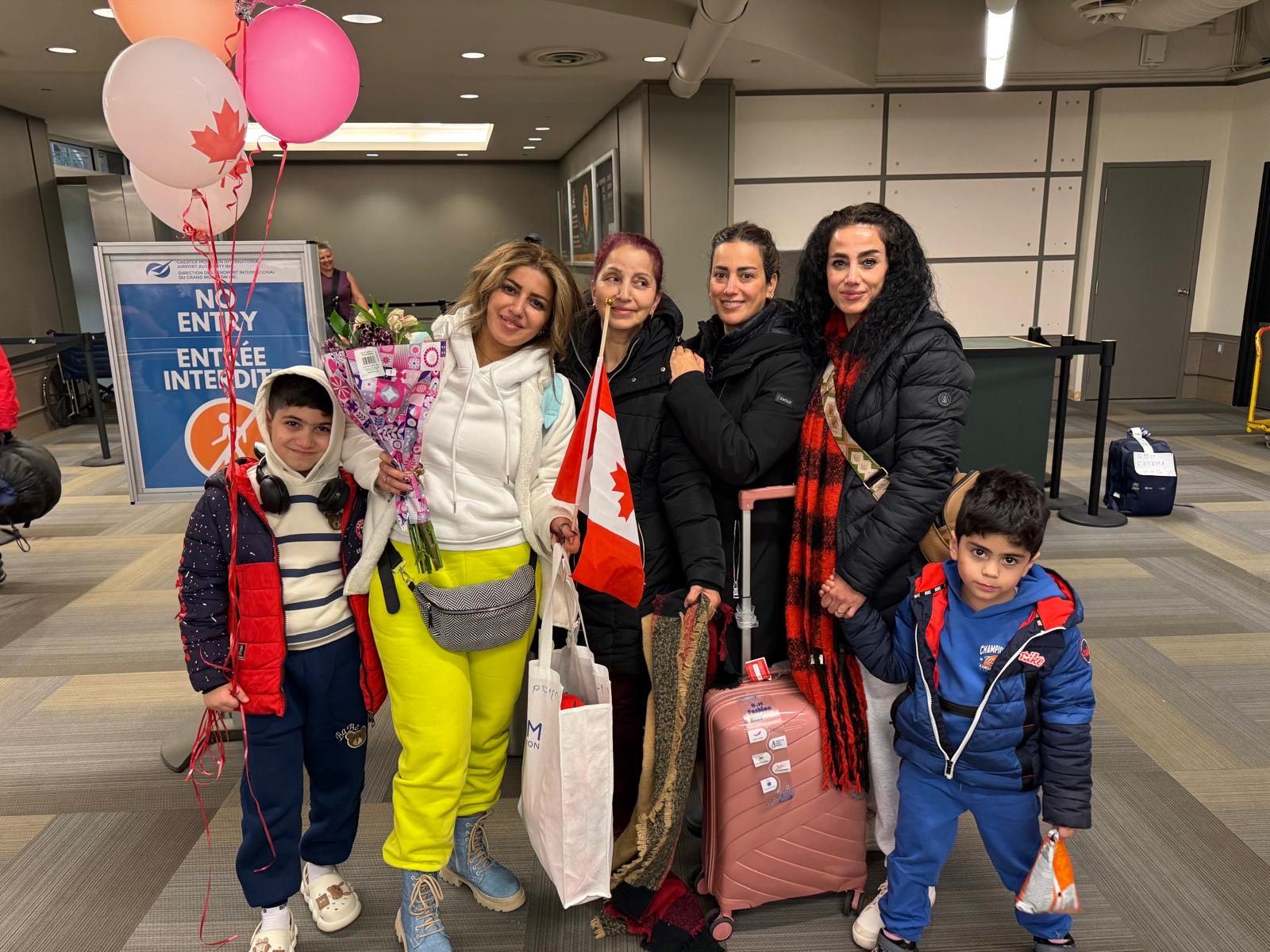
Ten months later, with official documents completed, Noura and Charbel boarded an airplane that would take them from Iraq to Turkey then to Toronto, Canada. They stayed overnight and then boarded the plane to Moncton, where they were met by their extremely happy Moncton family.
Noura is now living temporarily with one of her sisters. She has begun English language training with the hope of moving forward with some educational/career training so that she can get a job to support her and her son in their new life in Canada. Her son has begun school and is enjoying it and doing well.
Throughout the 7 years it took to get Noura and Charbel safely to Moncton, there were times when we were unable to share some of the information about Noura’s situation to ensure her safety. There have been expenses to support Noura with life sustaining needs, government applications and legal expenses. We used funds from our Syrian Relief account, but her family had to take on loans as well, to assist Noura, which they need to pay back. According to our agreement with the government, we are responsible for Noura and her son for 1 year. We are asking for your continued financial support this year, so we can meet our obligation to help Noura with food, clothing and shelter, so she can become independent.
Thank you for your care and concern. If you have any questions, feel free to reach out to the parish office.
St. Bernard’s Syrian Family Committee